Blog

Your blog category

Blog

How to Choose the Perfect Air Cooler for Your Room

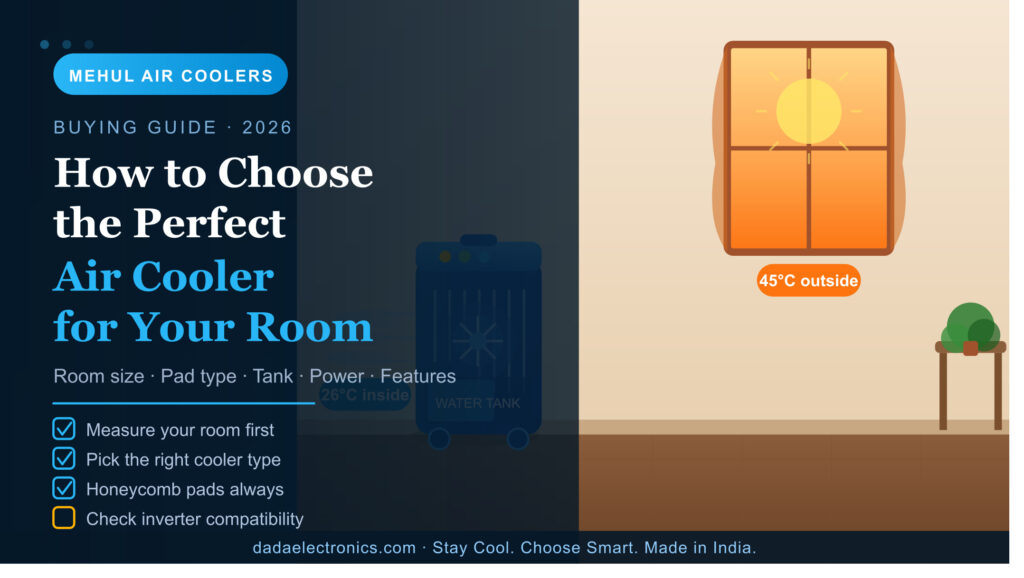
How to Choose the Perfect Air Cooler for Your Room Let me be honest with you. I have seen people walk into stores, pick up the flashiest-looking air cooler for room cooling, bring it home, and then complain all summer that it does not cool properly. Not because the cooler was bad. But because it was the wrong cooler for their specific room. Choosing the right air cooler for room use is not complicated — but it does require knowing a few things upfront. Room size, local climate, the type of cooling pads, water tank capacity, power consumption — these are the factors that actually determine whether your cooler will keep you comfortable on a 45°C afternoon in May, or just push warm air around and leave you sweating. This guide will walk you through everything you need to know to pick the perfect air cooler for room cooling — the way someone who has spent years in this industry would explain it to a friend. First, Understand What an Air Cooler Actually Before you start comparing specifications, it helps to understand the basic science behind how an air cooler for room use actually works — because this understanding will guide every decision you make. An air cooler for room cooling works on the principle of evaporative cooling. A fan pulls warm air from outside through water-soaked cooling pads. As the air passes through these wet pads, water molecules evaporate and absorb heat from the air, bringing down the temperature by anywhere between 5°C and 15°C depending on the conditions outside. This cooler, moistened air is then pushed into your room by the fan. This is why an air cooler for room use works brilliantly in dry heat — like the summers in Delhi, Jaipur, Nagpur, Lucknow, or Bhopal — and works less effectively in already-humid coastal cities like Mumbai or Chennai. The drier the outdoor air, the more effectively water evaporates from the pads, and the cooler the air that enters your room. Knowing this one thing — that humidity is the enemy of evaporative cooling — will prevent a lot of disappointment. Step 1 — Measure Your Room Before Anything Else This is the step most people skip — and it is the single biggest reason why people end up with the wrong air cooler for room cooling. Every air cooler for room use is rated for a specific coverage area, measured in square feet. An underpowered cooler will struggle to bring down the temperature of a large room, running constantly at maximum speed while barely making a dent in the heat. An overpowered cooler in a small room will make the space too humid and cold. Here is a simple guide to match your room size to the right air cooler for room capacity: Small rooms (up to 150 sq ft) — a bedroom, a small study, or a single room in a paying guest accommodation. A personal or tower-type air cooler for room use with an airflow of 500 to 1000 cubic metres per hour (CMH) is more than sufficient. These are compact, portable, and energy-efficient. Medium rooms (150 to 300 sq ft) — a standard master bedroom, a medium living room, or a small office cabin. Look for a desert or window air cooler for room with an airflow rating of 1000 to 2000 CMH and a water tank capacity of 20 to 40 litres. Large rooms (300 to 500 sq ft) — a spacious living room, a large hall, or an open-plan home office. You will need a high-capacity air cooler for room with airflow above 2000 CMH and a tank capacity of 40 to 60 litres or more. Open or semi-open spaces — a verandah, a garage workshop, a wedding mandap, or a shop floor. Industrial-grade air cooler for room or space cooling, with airflow above 3000 CMH, is what you need here. The formula for calculating the right airflow for your air cooler for room is simple: Required CMH = Room Area (sq ft) × Ceiling Height (ft) × Air Changes per Hour ÷ 35.3 For most homes, aim for 20 to 30 air changes per hour for comfortable cooling. Your cooler’s product page or box will always list its CMH rating — match it to your calculation and you will never go wrong. Step 2 — Choose the Right Type of Air Cooler for Room Use There are four main types of air cooler for room use available in the Indian market, and each is suited for a different situation. Personal Air Cooler A personal air cooler for room use is small, compact, and designed for individual use. It typically has a tank capacity of 10 to 20 litres and delivers airflow in the range of 500 to 800 CMH. If you want an air cooler for room use in your bedroom that you can keep right next to your bed, or if you live in a small rented room and need something portable that you can carry when you move, a personal cooler is the ideal choice. They are also the most affordable category, making them popular among students and working professionals. Tower Air Cooler A tower air cooler for room is tall and slim — designed to save floor space while delivering better airflow than a personal cooler. Tower coolers are a great choice for medium-sized bedrooms and living rooms where floor space is limited. They look stylish, cool evenly, and many modern tower air cooler for room models come with remote controls, auto-fill connectivity, and multiple speed settings. Desert Air Cooler This is the workhorse of the air cooler for room world. Desert coolers are large, high-capacity machines with tank sizes of 40 to 80 litres and airflow ratings that can exceed 4000 CMH. They are built for large rooms, halls, and semi-open spaces. If your living room or family gathering space is large and you experience genuinely dry summer heat, a desert air cooler for room

Blog

Why Air Coolers Are Better Than ACs for Indian Summers

Why Air Coolers Are Better Than ACs for Indian Summers Every year, as temperatures soar across the subcontinent, millions of Indian families face the same pressing question — should we buy an air cooler or invest in an air conditioner? It is a decision that touches on budget, health, comfort, and long-term practicality. For decades, the air conditioner has been aggressively marketed as the only serious home cooling solution. But for the vast majority of Indian households — particularly those in tier-2 and tier-3 cities, towns, and rural areas — an air cooler is not just a cheaper option. It is genuinely the smarter, healthier, and more practical choice for surviving Indian summers. In this blog, we explore exactly why an air cooler outperforms an air conditioner across every parameter that truly matters to Indian families. Understanding How an Air Cooler Works Before comparing the two appliances, it helps to understand what makes an air cooler and an air conditioner fundamentally different machines. An air cooler — also called an evaporative cooler or desert cooler — works on a beautifully simple principle rooted in nature. It draws in warm outdoor air, passes it through water-soaked cooling pads, and pushes out cool, moist, refreshing air into your room. No chemicals, no refrigerants, no compressors. Just water, a fan, and the physics of evaporation. An air conditioner, on the other hand, compresses and circulates a chemical refrigerant to absorb heat from inside a sealed room and release it outside. It is an energy-intensive closed-loop system that continuously recycles the same indoor air. This fundamental difference in how cooling is achieved explains almost every advantage an air cooler holds over an air conditioner — from cost and health to environment and practicality. 1. An Air Cooler Costs a Fraction of What an AC Does Let us begin with the most important factor for the average Indian family — price. A decent split air conditioner from a reputable brand costs anywhere between ₹35,000 and ₹70,000 or more, depending on the tonnage and star rating. Add installation charges of ₹3,000 to ₹5,000, an annual maintenance contract, and a voltage stabiliser, and the total cost of ownership climbs even higher before the machine cools a single room. A high-quality air cooler, by comparison, is available for as little as ₹5,000 to ₹15,000 for a model powerful enough to cool a medium to large room effectively. Even premium air coolers with advanced features like honeycomb pads, auto-fill systems, and remote controls rarely exceed ₹20,000 to ₹25,000. For a budget-conscious Indian family — and in India, that is most families — this price difference alone makes the air cooler the clear winner. Effective, reliable cooling at a fraction of the cost. The money saved can go toward something that actually matters to the family. 2. Electricity Bills — The Real Difference Begins Here If the purchase price of an AC does not stop you, the monthly electricity bill certainly should. A standard 1.5-ton split air conditioner consumes between 1,200 and 2,000 watts of electricity per hour. Running it for just 8 hours a day through a 4-month Indian summer adds up to an enormous number of units — and a correspondingly painful electricity bill every month. An air cooler, in sharp contrast, consumes between 100 and 400 watts depending on the model and fan speed. That is roughly one-fifth to one-tenth the power consumption of a comparable air conditioner. For a family running their air cooler 8 to 10 hours daily through April, May, June, and July, the electricity savings can easily amount to ₹3,000 to ₹6,000 per month. Over a full Indian summer, a good air cooler can save your household ₹12,000 to ₹25,000 compared to running an AC. Multiply that over the 7 to 10-year lifespan of the appliance and the financial case for an air cooler becomes absolutely overwhelming. 3. Air Coolers Add Healthy Moisture — Perfect for Dry Indian Summers Here is something that air conditioner salespeople rarely tell you. Air conditioners do not just cool the air — they actively strip moisture out of it. The refrigeration cycle removes humidity from indoor air as part of the cooling process, which is why rooms cooled by an AC often feel cold but also uncomfortably dry and artificial. This is a serious issue during Indian summers, particularly across northern, central, and western India where the seasonal heat is predominantly dry. The combination of harsh outdoor heat and AC-induced indoor dryness can cause dry and cracked skin, severely irritated eyes, persistent throat discomfort, worsening of sinusitis, and aggravation of respiratory conditions like asthma and allergies. An air cooler works in the opposite direction. Because it cools the air through water evaporation, it naturally adds a healthy level of humidity to your indoor environment. This moisture is not just comfortable — it is genuinely beneficial for your skin, your respiratory system, and the overall liveability of your home. For regions like Rajasthan, Uttar Pradesh, Madhya Pradesh, Gujarat, and large parts of Maharashtra that experience intensely dry heat during Indian summer months, an air cooler is demonstrably better for your family’s health than running an air conditioner all day and night. 4. No Installation Required — Just Plug In and Stay Cool Installing a split air conditioner is a major undertaking. It requires drilling holes through walls, mounting an outdoor compressor unit, running copper piping and electrical conduits, and calling in a certified technician. The process can take half a day, disrupt your home, and may not even be permitted in a rented apartment where permanent modifications to the property are not allowed. An air cooler requires none of this. You take it out of the box, fill the water tank, place it near a window or ventilated area, plug it into any standard power outlet, and it is cooling your room within minutes. There is no installation cost, no technician visit, no drilling, and absolutely no damage to your walls or property. For the millions of

Scroll to Top